Friday, 7 February 2014

CBC Ombudsman and Management Agree CBC Contravening Journalistic Standards


CBC agrees that it has contravened its own journalistic policies.  CMRI found several instances where CBC failed to live up to its standards. First, we observed how public opinion polls were being reported without adhering to policies established decades ago. These policies ensure that the methodology in polls meet high research standards and are reported in a transparent fashion for the audience.

Then, we highlighted the improper use of online surveys, which CBC has of late implied are representative of public opinion or the audience’s views, rather than those who choose to respond to such online questions.  It is CBC policy to ensure the audience understands such survey results are not representative and CBC is violating the policy.  

Finally, we brought attention to the fact that Rex Murphy’s regular segment on The National was being presented as CBC’s opinion rather than that of Mr. Murphy. CBC had not noticed that the label identifying the segment as Mr. Murphy’s opinion had gone missing from the program almost five years earlier, prompting John Doyle to tweet that it was “shocking laxity.” CBC quickly re-introduced the label “Point of View,” which now appears throughout the segment.

CBC’s Ombudsman wrote a thorough and clear review of CMRI’s complaint.  The summary stated: “The complainant, Barry Keifl (sic), who runs Canadian Media Research and used to work here at CBC, had some concerns about some features on Power and Politics. He thought other programs were not living up to CBC’s polling policies either. He was right in at least two cases. Power and Politics is not living up to the rigors of CBC policy on polling in a couple of their regular features. I suggested CBC lay out some standard processes for polling approval and presentation.”

As a result, some changes in how poll results are presented on Power and Politics have already been introduced and the producer has indicated changes will be made in how online survey results are presented.  The latter, by policy, should not be characterized as percentages, only as raw vote totals, and it will be interesting to see if the program abides by the policy in future. 

The Ombudsman and CMRI disagreed about a segment of the program called Political Traction.  CMRI felt that it was being presented as though it were a poll, possibly misleading the audience.  The Ombudsman disagreed but the segment now concludes with a description of the methodology, where none had been present.  The very day the Ombudsman released her review, Political Traction contained a statement about “what Canadians are saying” about Justin Trudeau’s Senate decision.  Such a statement suggests that the results are representative of Canadians, i.e., a poll, when clearly they are not.

Political Traction Says it Knows What Canadians are Saying (@1'50")


CBC management responded positively to the complaint about polls and online surveys in a separate communication: “…the Ombudsman review reminds us that new ways of storytelling can't come at the expense of our journalistic standards. You can be sure we'll re-examine and tighten up our processes where necessary.” 

As for Rex Murphy, CBC management also addressed his status in a another communication this week: “The most important thing to understand is that Rex is not a regular reporter. He appears on The National as a commentator precisely to do analysis and offer his point of view on issues of the day…. As much as Rex is identified with the CBC, he is not a full-time employee of the CBC….his point of view is his own.”  Several people responded to this defense of Rex Murphy’s segment and raised some important issues, which I recommend you read.

This is fascinating in one very important respect.  CBC has for decades employed commentators or outspoken journalists like Rex Murphy, Jason Moscovitz, etc. Their role has always been explained as it was this week by the head of CBC News.  There is a sense of déjà vu.  CBC has been through all of this before but, like the forgotten label, seems to be forgetting its roots.

CBC journalism has traditionally occupied the high ground, providing the best news and current affairs, including commentary.  In a broadcasting environment controlled by Rogers, Bell and other conglomerates, the future of the CBC rests on its journalism.  Sports, such as the NHL, will henceforth be controlled by the conglomerates.  They can also purchase the best entertainment programming from Hollywood and the rest of the world and they have the resources to take greater risks in Canadian entertainment programs.

The one area where CBC can still compete is news and current affairs. CBC TV and CBC New Network spent over $200 million on news and current affairs in 2012, according to the CRTC, so we expect and deserve high quality from the public broadcaster.  Even if competitors wanted to spend more on news, it wouldn't necessarily displace CBC's central role.  Thus, any relaxation of CBC journalistic standards only plays into the hands of those who want to get the CBC on their ‘level playing field,’ which will be the undoing of the public broadcaster.  

Wednesday, 15 January 2014

Is CBC Abandoning the Basic Principles of Public Broadcasting?


Important update:  After being notified that the label "Point of View" no longer appeared on Rex's segment, CBC informed me that it will be re-introduced within a few days.  Kudos to Peter, Rex and CBC News.

Another Update: Rex Murphy's "Point of View" returned on January 17, 2014, as shown in the photo at bottom of post.


Has CBC deserted its journalistic standards? CBC has mission statements and policies that are appropriate to a public broadcaster, including extensive policies relating to journalism, the crown jewel of CBC.  But CBC is ignoring these journalistic standards and appears to be in violation of its own policies virtually every day.  We will examine some concrete examples. 

A small but telling example of CBC veering from its own journalistic policies is the case of opinion polls, which was dealt with in an earlier post.  During the 1980’s, following the first Quebec referendum, senior management grew concerned about journalists designing and reporting on polls and possible effect of polls on elections.  A policy was created to ensure oversight by the professional survey researchers in the CBC research department, and reporting standards dealing with survey methodology were established. Most major newspapers began following CBC’s example and started reporting sample size, margin of error, etc.  

The policy on polling appears to have been jettisoned by both CBC radio and TV.  Programs like The House, The National, Day Six, Power and Politics and regular newscasts present poll results with little and sometimes no reference to methodology. 

Online surveys are another case in point.  They are being used virtually every day by CBC programs— ignoring the CBC policy that “If programs refer to online questions, the results are reported in a way that clearly indicates it has no scientific validity and are not meant to represent the accurate range of either public opinion nor the opinion of our audience.”  Such surveys are specifically prohibited by the policy from “giv(ing) the results as a percentage, as we normally do with bona fide polls.”  Yet they all do, in direct contradiction to the policy. 

Decades ago CBC research determined that callers to Cross Country Checkup or those who write to CBC, i.e., online surveys, are not representative, but this knowledge has seemingly been discarded, along with journalistic policies.  How can legitimate polls possibly have any credibility in this environment?

A more serious concern is the CBC’s new-found approach to presenting opinion in news programs.  CBC TV and radio have journalistic policies dealing with the expression of opinion.  The policy states: “CBC journalists do not express their own personal opinion because it affects the perception of impartiality and could affect an open and honest exploration of an issue.”  If a guest or commentator offers an opinion, CBC must identify their affiliation or special interest.  The policy also states: “We maintain the same standards, no matter where we publish - on CBC platforms or in other media outside the CBC.”

Yet, Rex Murphy, one of CBC’s best known broadcasters, offers a regular opinion segment on The National, the nightly news program, and his pieces are archived on the CBC’s web site and YouTube, where there is no reference to his segment being commentary or opinion.  That was once the case, as per policy, but now it is implied that Rex represents not himself but CBC.

Rex’s segment ceased being labeled "Point of View" five years ago but nobody seems to have noticed.  The change occurred the same week that the news anchor for The National began reading the news standing up, emulating the sense of urgency in Eyewitness news programs.  Likewise, CBC Radio newsreaders have taken to offering spontaneous opinions about people and events, albeit usually celebrities and lighter items, in hourly newscasts.  This practice, along with a private media-like emphasis in local news on accidents, fires and crime, has crept into the radio news service the last few years.

The reasons for this are complex and will be addressed in future posts. What is clear is that CBC journalistic standards are now similar to those of any other broadcaster. Have CBC senior managers and its Board of Directors carefully considered the strategic direction being taken by the radio and TV networks?   


Rex Murphy October 22, 2009
Rex Murphy October 30, 2009
Rex Murphy January 17, 2014


Monday, 30 December 2013

CBC's Response to Violations of its Journalistic Policies

The previous post expressed concerns about how CBC has been presenting results of opinion polls and online surveys.  The post was sent to the CBC Ombudsman and the Executive Producer of Power and Politics was good enough to respond and explains that her program will take steps to improve how polls are presented.  Her response follows and afterwards are my comments to the producer: 


From: Amy Castle
Sent: Tuesday, December 24, 2013 11:56 AM
To: bkiefl
Cc: CBC Ombudsman
Subject: Letter to CBC Ombudsman
December 24, 2013
Dear Mr
Kiefl,

Thank you for sharing your recent blog post
  with the CBC Ombudsman regarding Power & Politics.  As the Executive
  Producer, I can tell you your feedback is essential to how we do our work.

I must, however, disagree strongly with your
  suggestion that our program is "ignoring a vital area of CBC
  journalistic policy." On the contrary, we're very much living up to our
  Journalistic Standards and Practices.
You raised a number of concerns in your blog post.
 Let me respond to each of them in turn.

In terms of our weekly segment “Political Traction”
with Jaime Watt, you say “CBC should not be implying that this is
representative of Canadians and therefore possibly leading viewers into
thinking that Navigator has conducted representative polling.”

At no point do we characterize Political Traction as a poll.
 Rather, we are clear on the show and on our website that Jaime Watt is
tracking the political conversation in Ottawa
and across Canada.
 The goal of the segment is to discuss which political issues are trending
in the Canadian conversation, and to highlight the differences - if any - in
the conversation being held in Ottawa
compared to the national conversation.

The Traction methodology is explained on our website here: http://www.cbc.ca/news/politics/political-traction-how-it-s-done-1.1031158.  
I am attaching to this note a detailed breakdown of that
methodology.

You say that “Power and Politics should be more forthright
about the methodology used by Navigator.”  Although we have the
methodology on our website, I will ensure that we remind our viewers on air
where to find details of that methodology.

Regarding our weekly feature, The Nanos Number, pollster Nik Nanos
draws on a number of polls from reputable sources and we are always clear where
the polls come from.

CBC’s policy states this: We report polls not commissioned by CBC as long as we can verify that the
methodology meets CBC standards.  The sample size, methodology and
interpretation of results of non–CBC polls should be reviewed by the CBC
research department. To help our audience place a poll in context, we provide
relevant information about the methodology and size of the sample along with
the results. Where applicable, we provide the margin of error.

We abide by these rules with the Nanos Number.  All polls
used in the Nanos Number meet CBC standards.  We also provide information
on the methodology, size of the sample and margin of error.  These details
are clearly stated on our website
http://www.cbc.ca/news/politics/the-nanos-number-1.1134156
I agree with you, however, that the information is difficult to
read when we post it on television.  This is due to a new graphics programme
that we recently started using.  I am currently working with our graphics
designer to ensure that our graphics are upgraded to ensure that the font is
more easily readable on air.

You raise concerns that Mr Nanos is using crowdsourcing in his polling.
 In fact the term crowdsource is a Nanos tradename and should not be
confused with a process.  The Nanos polling methodology includes a sample
of random land and cell lines where people are randomly selected to do a study
online.  His methodology is robust and meets our strict CBC standards.

Regarding our daily Ballot Box segment, interaction with our
audience is an important part of our show.  We welcome comments from
viewers, and encourage participation in our daily political conversation.
 The Ballot Box is an important part of that interaction.  

At no point do we refer to the Ballot Box as a poll.  As you
mentioned, we are transparent in showing the number of votes on screen whenever
the Ballot Box appears.

I will, however, ensure that the number of votes gets posted
online along with the percentage results at the end of each day.

Thank you very much for your feedback. It is also my
responsibility to tell you that if you are not satisfied with this response,
you may wish to submit the matter for review by the CBC Ombudsman. The
Office of the Ombudsman, an independent and impartial body reporting
directly to the President, is responsible for evaluating program compliance
with the CBC's journalistic policies. The Ombudsman may be reached by
mail at Box 500,
Terminal A, Toronto, Ontario M5W 1E6,
or by fax at 
(416) 205-2825, or by e-mail at ombudsman@cbc.ca.

Sincerely,
Amy Castle
Executive Producer, Power and Politics
CBC News Network
www.cbc.ca/politics

My Response to the Executive Producer of Power and Politics:

Ms. Castle, thank you for the response.  Below are my comments and concerns:
  1. Navigator or Political Traction: Your suggestion of “…ensur(ing) that we remind our viewers on air where to find details of th(e) methodology” would be beneficial and resolve my concern about Navigator. Putting that information on your web site is good but an on-air explanation is excellent.  I suspect only a handful of viewers have ever seen the web site reference.
  2. Nanos Number:  I think it is good that you are “currently working with (y)our graphics designer to ensure that…graphics are upgraded to ensure that the font is more easily readable on air.”  However, while I recognize that this would improve the viewer’s understanding of the polling methodology, the spirit of the policy on reporting polls would be better reflected if you did more than include a graphic, legible or not, with sampling details, etc.  A half minute explanation of the methodology is warranted and would add credibility to what Mr. Nanos says about results.  Mr. Nanos also appeared recently with Evan Solomon on The House and discussed poll results dealing with the PM’s credibility; there was scant reference to polling methodology.  Poll results from an unspecified source dealing with CPP were reported on December 16, 2013 on CBC News Network and again, there was no reference to methodology. So, this appears to be a wider issue than the Nanos Number on Power and Politics and I would appreciate your alerting Jennifer McQuire to this concern.  
  3. The Ballot Box:  the policy dealing with online surveys, which I had a hand in drafting, was to ensure that viewers/listeners understood specifically that such “surveys” are not scientific in any way.  The policy was to make that absolutely clear and so I suggest you include a reference to Ballot Box being unscientific each time you present the results in graphic form on air.  Moreover, my understanding of the policy dealing with online surveys is that only raw vote numbers will be presented; percentages will not be presented under any circumstances.  I appreciate your offer to “ensure that the number of votes gets posted online along with the percentage results at the end of each day.” But I believe this is a misinterpretation of the policy. Percentages should not be presented in any form.   To quote from the policy: “We report the results by giving the number of votes cast for each option. We do not give the results as a percentage, as we do with bona fide polls.”  So, including raw numbers on air and on your web site follows the policy but including percentages with or without the raw numbers violates the spirit and the letter of the policy.  I note that a number of CBC programs are using online surveys and all of them violate the policy by including just percentages on their web sites.  These include Day Six, Q and The National and I would appreciate your also bringing this to the attention of Jennifer McQuire.  (The online survey by The National gives percentages to two decimal places, giving the impression the results are especially accurate.)

While the above may seem like nitpicking to someone producing a show as fast moving and well produced as Power and Politics, I assure you that my concerns about CBC journalistic policy are much greater than how polls are presented.  CBC journalism has always occupied the high ground and relaxing journalistic standards only plays into the hands of critics who want to get the CBC on their ‘level playing field’. I firmly believe that the future of the CBC will be determined by the quality of its journalism and slippage in journalistic standards will spell the end of CBC TV and radio.
Barry Kiefl

Thursday, 5 December 2013

CBC Journalistic Policy Benched?


CBC’s weekday two-hour program, Power and Politics, covers politicians and political events in more depth than any other program on TV.  It carefully balances the time devoted to the political parties, ensuring all the main parties and their views are represented on various panels, etc.  Its choice of topics tends toward political scandal and sins, making it no different than most other media but that’s another topic.  For reasons unexplained, Power and Politics is ignoring a vital area of CBC journalistic policy.  CBC carefully developed journalistic policies relating to opinion polling and posts them on its website. However, basic tenets of the policy are ignored in almost every edition of Power and Politics.
 

The CBC policy in question states: “We report polls not commissioned by CBC as long as we can verify that the methodology meets CBC standards. The sample size, methodology and interpretation of results of non-CBC polls should be reviewed by the CBC research department. To help our audience place a poll in context, we provide relevant information about the methodology and size of the sample along with the results. Where applicable, we provide the margin of error.”

Two different non-CBC “polls” or what seem to be polls are regularly featured on Power and Politics, The Nanos Number and Navigator.   

Navigator is an example of non-CBC research that seemingly violates CBC policy.  The avuncular Jamie Watt, chairman of Navigator, a successful political consulting firm, appears on his own segment of Power and Politics and presents data that both he and Evan Solomon, host of Power and Politics, imply are representative of “Canadians.” In fact, only after digging into Navigator’s website does one learn that the "tracking" percentages characterized as being representative of Canadians are based primarily on analysis of blogs, online comments, Twitter, and comments on political talk shows (presumably including comments by Jamie Watt and his staff who appear on such programs.)  


There is nothing wrong with someone analyzing tweets and online comments but CBC should not be implying that this is representative of Canadians and therefore possibly leading viewers into thinking that Navigator has conducted representative polling.  We know that relatively few people tweet and research, including some done by CBC, determined that those who bother to write newspapers or call talk shows, etc. are generally not representative of either the audience or the population. Power and Politics should be more forthright about the methodology used by Navigator.

The Nanos Number, a product of Nanos Research, is also a regular segment on Power and Politics but featuring actual poll results.  Survey results on some occasions appear to come from a conventional telephone poll, while on other occasions, results are based on what Nanos calls an “RDD Crowdsource random survey of 1,000 Canadians… recruited by telephone through the proprietary Nanos Crowdsource sample and administered a survey online.”   Crowdsourcing has been used to fund entrepreneurs but it is very unclear how it has been used here. The Nanos Number segment, featuring the amiable and professional Nik Nanos, usually provides little or no information about the methodologies, other than an illegible footnote partially obscured by program graphics. One must go to the Nanos website to learn how the surveys have (presumably) been conducted.  So, once again, this seems to be in violation of the CBC’s journalistic policy.  Power and Politics should be transparent about the Nanos surveys and “provide relevant information about the methodology.”


CBC should utilize its in-house experts in survey research.  In one recent Nik Nanos segment on CBC radio’s The House, Evan Solomon did not accurately read the survey question put to respondents, perhaps because the question, which dealt with the Prime Minister’s credibility, seemed awkwardly worded, something CBC researchers and journalists should pick up on.

The third poll-related segment that regularly appears on Power and Politics is called The Ballot Box.  Each night a different survey question is put to viewers and visitors to CBC’s website and they are encouraged to vote online.   The CBC journalistic policy regarding online surveys is exceptionally well thought out and clear: “Online surveys are a tool of audience engagement. Since it does not fulfill any of the criteria set out in polling policy, the questions and the results are not characterized as polls. We report the results by giving the number of votes cast for each option. We do not give the results as a percentage, as we normally do with bona fide polls. If programs refer to online questions, the results are reported in a way that clearly indicates it has no scientific validity and are not meant to represent the accurate range of either public opinion nor the opinion of our audience.”   Power and Politics, which could be re-christened Polls and Politics, is clearly violating the CBC standards with regards to how these online results are being presented.  cbc.ca only presents percentages and during the program percentages are presented along with raw results.  In my view this lends an air of polling legitimacy to The Ballot Box, which is not warranted, as any professional researcher and experienced journalist knows.

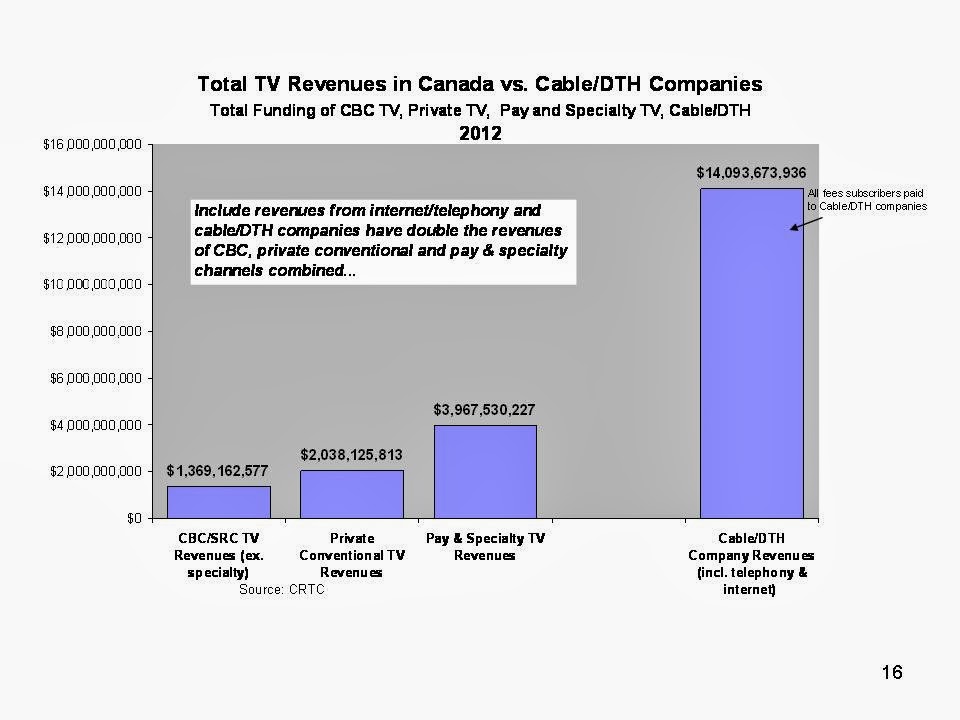
CBC TV is under greater duress than at any point in its history.  In recent years its role in our lives has been usurped by other broadcasters and media, the most recent example being a much reduced role in the broadcasting of NHL hockey.  Over time the funding that all Canadians provide to the CBC via Parliament has been reduced. Today we give our money, many times more than we ever provided to CBC, to private media conglomerates such as Rogers and Bell; for better or worse they have used those funds to push CBC out of many program areas. The one critical element that CBC TV and radio offer to Canadians still unmatched by private radio and TV is quality journalism.  That quality has been maintained because of the excellent journalists who work at CBC and CBC's journalistic standards.   Hopefully, Power and Politics will re-visit those standards.

While were at it, Power and Politics could you please stop running the same two or three commercials targeted to pensioners and the elderly day after day, hour after hour. Yes, I remember Paul Henderson's goal in 1972!  Does the sales department think CBC's older viewers have such impaired memory they can’t remember commercials aired every day for months and just minutes earlier?

Wednesday, 15 May 2013

CBC’s Audience Crisis: CBC TV Audience is Down 40%, Lowest in History

CBC TV has an audience crisis, according to the most recent data released by CBC.  CBC is required by the government to report on its financial and audience performance on a quarterly basis.  Quarterly reporting began in 2011-12.  Reports are issued for the first three quarters of the year and the annual report presents results for the full year.

To its credit CBC is revealing more information about its performance than it has in recent years.  Once upon a time CBC was transparent about its finances and its audiences but competition today has meant smaller audiences, at least in TV, and there has been less for the Corporation to boast about and more to be defensive about. 

The metrics CBC uses to measure performance run the gamut from content percentages to revenues obtained from advertising and other sources.  To measure audience performance CBC uses audience ‘share’, ‘listening/viewing hours’, ‘average minute audience’, ‘subscriber counts’, ‘unique visitors’ and opinion scores.  One needs to be an expert in audience measurement to work their way through this maze of information.  I doubt that many CBC Board members or senior managers understand or could explain it all.

Moreover, the measures are not applied uniformly across all CBC services.  The main TV services are measured by share, the smaller specialty TV channels by subscriber counts (not an audience measure), radio morning shows and supper hour TV programs by weekly listening/viewing hours, the web sites by monthly visitors, etc.  English and French services also differ in the metrics used for similar services.

CBC, again to its credit, attempts to measure public reaction to its services rather than rely strictly on measures of audience size or ratings.  Ratings data are provided by independent third-party ratings organizations but to measure public reaction CBC commissions its own surveys.  This, of course, means the surveys could be perceived as biased.   Little information is provided about these custom surveys.  We are assured that the sample of respondents results in “a very small margin of error.”  Survey results are provided in each quarterly report as shown in the table below, showing the agreement scores (out of 10) for various traits of CBC radio and TV as a whole:     


In the quarterly reports differences in the opinion scores of .1, .2 or .3 in these or similar traits are described as indicating a trend.  For example the 2011-12 third quarter report claims: “Results…suggest that Anglophones are responding positively to the initiatives that have been announced or introduced since the launch of Strategy 2015. Scores for each aspect of the guiding principles were higher in November 2011 than in November 2010.”

But these small differences in the scores, some of which turned negative by the third quarter of 2012-13 as shown above, are probably not statistically significant.  More importantly, is this the correct way to measure public reaction to CBC services?  Asking Canadians whether CBC radio, TV and web services as a whole are informative, enlightening or entertaining is almost certainly going to elicit a positive average score.  Survey researchers know this. CBC offers many services and some people will be answering for CBC radio, some for CBC TV, some for CBC News Network, some for their favourite CBC shows or personalities or cbc.ca, etc.   Besides, ask the same question of CTV or TVA and you will probably receive similar scores.  So what is the purpose of asking questions that fail to capture year-to-year changes and that do not differentiate between CBC services or other broadcasters?   CBC needs to rethink how it measures public reaction.

The various measures of audience size used by CBC are shown in the table below, taken from the most recent quarterly report for 2012-13:


To measure the size of the audience of cbc.ca, a third-party estimate of unique monthly visitors is used.  The most recent number is 6.1 million monthly visitors, slightly below the target of 6.5 million visitors.  Previous quarterly reports broke down this number to distinguish between CBC online news, sports and entertainment but this was for some reason “discontinued.” The monthly visitor or reach number seems impressive at first glance but if one were to compare this to other web sites, it would become apparent that hundreds of sites generate a large audience reach over the course of a month.  To be counted one need only visit a site for as little as a few minutes in a month. A more telling number would be the audience share of time spent browsing the internet.  However, because the net has thousands of web sites all competing for audience, cbc.ca has a small share of browsing time, not something web sites want to divulge.

To measure the size of the CBC radio audience, a third-party estimate of audience share is employed.  The most recent share for CBC radio is reported as 15.3%, a full share point ahead of the target for the year.  CBC radio, despite internal and external budget cuts remains strong.  Unfortunately, Radio 1 and Radio 2 are not broken out separately, so we don’t know if one is trending higher and the other lower. 

Without explanation, CBC employs a different audience metric for Radio 1 morning shows, reverting to weekly listening hours.  Since share is simply the percentage of listening hours of CBC compared to time listening to all radio stations, it would be simpler to use share here as well.  CBC French radio in the same report uses share. However, millions of hours sounds more impressive.  The silver lining: listening hours allows one to compare to the viewing hours of CBC TV’s supper hour programs, which, interestingly, are only half the size of the radio morning shows.  The radio morning shows and the supper hour TV news programs are the most important local programming offered by CBC.  (Note to CBC researchers: the footnote sourcing the radio listening hours is incorrect.)  

The metric that shows the most change in the latest quarterly report is the audience share of CBC TV. 

The prime time share of CBC TV is reported as 5.3% at the mid-point of the TV season.  This is a loss of over 40% compared to the 9.3% share in 2010-11.  The report comments on this decline:  “For CBC Television, reduced programming as a result of the funding decreases announced in Federal Budget 2012, the absence of professional hockey due to the NHL labour disruption and the phasing-out of the LPIF contributions had significant programming and revenue implications on our conventional and digital platforms. CBC Television’s share performance fell from the prior year’s results and is trending below target.”  Not mentioned is that 2012-13 also marked the first year without U.S. game shows in the CBC’s prime time schedule, which, combined with NHL hockey, served to cover up weaknesses.  With the return of the NHL mid-season and some extra games added to the schedule, CBC’s share would recover somewhat but at best would be 2 share points or 20% lower than two years ago.

The first and presumably most important factor used to explain CBC TV audience losses, cuts in the federal funding, also affected other CBC services but they managed to exceed or come close to targets.  Worth noting: CBC radio’s share is now three times larger than the audience share of CBC TV. 

If the share of CBC TV was just over 5% in prime time, it is below 5% on a 24 hour basis; CBC daytime schedules have traditionally performed poorly compared to CBC’s prime time. Making matters worse is that the audience to about half the U.S. TV stations available in Canada are no longer being measured by the ratings company and neither are services such as Netflix or Apple TV, meaning that CBC’s share of all TV viewing is actually lower than the numbers suggest. This is the lowest audience share in CBC’s history and yet there is no hint of the severity of the TV network’s situation in the quarterly report.  CBC TV audiences are sold to advertisers and with less audience to sell, 2012-13 revenues, shown in the table above, are almost $40 million less than at the same point the previous year, creating a revenue shortfall that, when added to federal cuts, may be crippling.

There has been some public debate about whether or not CBC is in crisis.  The CBC’s latest report confirms that many programs on the main TV service, despite efforts to be more “popular,” have fallen to audience levels not much greater than many specialty channels.  Those who deny the crisis fail to realize that Canadians prefer Duck Dynasty to most CBC shows, including the national news. The most important and costly CBC service has an audience crisis and CBC needs to respond to it.  Is it time to rethink the role of CBC TV?   

Friday, 10 May 2013

Do We Want Canadian Movies or Drama Series on TV?


Movies have been a staple of TV networks since the dawn of TV.  I fondly remember spending Saturday afternoons in the early 1950’s at my grandfather’s house watching old westerns on CBC TV.  Granddad was the only one on the block with a TV and we lived just down the street, so I never missed a Saturday. When we got a TV a few years later the only show it seem to pull in was Bishop Sheen, the first TV evangelist.  Because it seems old fashioned there are some TV network honchos, who we'll keep nameless, who think movies on TV are passé and people are no longer interested in watching movies on TV networks. Well, what do the people have to say about this?

CMRI has tracked public opinion about what types of TV programs people are interested in for the past decade. We present a list of 40-45 different genres of programs to people, depending on the year, and ask them to tell us how interested they are in each genre.  Not surprisingly, local news has always come in first when ranked against all other types of program.  Infomercials have finished last every year.  Drama series score quite high with about 60% of viewers saying they are very interested/interested and the results have been consistent over the past ten years: 


But Hollywood movies get even higher scores with over 70% reporting they are interested in seeing Hollywood flicks on TV.  In fact Hollywood movies are the highest ranking fiction genre in our surveys year after year.  What's more, about 1 in 4 viewers say they are very interested in Hollywood fare, significantly higher than the proportion saying they are very interested in TV series:

Now for the bad news.  The percentage of Canadians saying they are interested in Canadian drama programs is well below that of drama in general or Hollywood movies.  Under 40% of people express interest in seeing Canadian drama, a problem that has been addressed here:

There's a silver lining, however.  For the past 5 years we have asked about Canadian movies on TV and, interestingly, Canadian movies fare better than Canadian drama series.  On average over the past five surveys, approximately 60% of people say they have an interest in seeing Canadian movies on TV.  That is equal to the interest in all drama series, including U.S. series:


Perhaps people instinctively feel that the quality of Canadian movies is greater than Canadian series.  A movie or mini-series often takes more risk and is less subject to bureaucratic funding rules and creative interference from networks.

So the representative sample of 15,000 or so people we have interviewed over the past decade say they are more interested in movies on TV than TV series.  The TV network honchos might be well advised to spend some time talking to actual viewers before jumping to conclusions about what people want.
 

The 2011 survey results are from CMRI's Media Trends Survey conducted November-December 2011 among a representative national sample of approximately 900 Anglophone respondents aged 18-plus.  Margin of error +/-3.3%.  The Media Trends Survey has been conducted for ten consecutive years and has surveyed over 15,000 Canadians in total. In our analysis we usually only report Anglophone results.   Both Anglophones and Francophones have been surveyed in this period, using questionnaires in each respective language.  Francophones have been surveyed in 5 of the 10 years.  To compensate for poorer response rates among younger adults results are statistically weighted in keeping with industry standards.  It is the only survey to have measured media use and attitudes continuously over this decade. The Media Trends Survey is not sponsored by any one industry or affiliated with a media company.